


Managing money in 2026 is all about flexibility, convenience, and low-cost financing. One financial trend that continues to gain attention is Credit Card EMI (Equated Monthly Installment) options — a way to pay for purchases in small monthly installments instead of one lump sum.
At the same time, banks are offering more free cards, meaning cards with no joining or annual fees. But a big question arises: Can free credit cards really give good EMI options, or are they just limited tools for basic users?
This article explores how no-fee cards work, how EMI conversions function, and whether combining both is a smart or risky decision for consumers in 2026.
What are Free Credit Cards in 2026
Free credit cards, often called “lifetime free cards,” are cards that come with no joining fee or annual maintenance charges. They’re designed to attract new users or those who want credit card benefits without paying extra yearly costs.
In 2026, many banks and fintech companies promote these cards as entry-level tools to help consumers manage cash flow, build credit history, and make purchases affordably.
For instance, banks in India, the USA, and Europe now commonly market cards like “Lifetime Free Rewards Card” or “Zero Annual Fee Cashback Card” as part of their basic credit line products.
While the no-annual-fee feature is attractive, the real question lies in the EMI conversion quality—how good are the interest rates, tenures, processing fees, and eligibility requirements on these cards compared to premium ones?
What Are EMI Options on Credit Card?

EMI conversion on a credit card allows you to take a purchase you’ve made and split the cost into smaller monthly payments. This can be especially helpful for large-ticket purchases like smartphones, appliances, furniture, or travel packages. Many banks now offer what is called “no-cost EMI” or “zero-cost EMI” programs, subject to certain conditions.
Key Features of EMI Options:
- Interest Rates: Many banks advertise “no-cost EMIs,” but often, there are processing fees or product price markups. True zero-cost EMIs exist but are usually limited-time offers.
- Tenure Flexibility: EMI durations commonly range from 3 to 24 months. Some banks even extend up to 36 months for high-ticket purchases.
- Minimum Purchase Requirement: You typically need to spend at least $2,500 (or equivalent in your country’s currency) to qualify for EMI conversion.
- Processing Fees: Some issuers charge 1–2% of the transaction amount as a conversion fee.
In simple terms, EMI features make credit card purchases affordable — but understanding the fine print is essential to avoid hidden costs.
The 7-Year Credit Rule and Why It Matters
The seven-year rule for cards is in reference to how long negative information can be reported on your credit history that relates to credit card accounts, including late payments, charge-offs, and defaults etc. According to the Fair Credit Reporting Act (FCRA), most negative credit card reports disappear seven years from the date of the original delinquency that caused the problem.
After that time, the credit bureau must delete that item, which can help to improve your credit score in time. The seven-year rule would not apply to positive credit history, wherein good accounts can stay on your report up to 10 years, reflecting good use of credit.
Are Free Credit Cards Worth It for EMI Plans in 2026?
1. Availability of EMI on Free Cards
Yes – most significant banks now provide EMI conversion options on both paid fee and no-fee credit cards. For example, studies reported that lifetime free cards can include EMI or conversion features for purchases above the threshold. Therefore, the access barrier (the first barrier) is generally cleared: you could avail an EMI programme for lifetime free cards as well.
2. Interest Rates & Tenure Comparisons
The critical comparison is in interest rates and the ability to change tenure repayments. Premium cards might give you lower interest, better partners tie-ups, longer tenure, or may just tend to offer zero-cost EMI for more frequent options. Free cards might offer comparatively slightly higher interest, or the initial promotional offer might be scarce. However, considering the typical high revolving balances or personal loan interest, even the slightly lower value EMI plan is better in affordability.
For example, an EMI conversion on one website lists interest at ~15.99% with terms between 3–24 months. Tenure is there too; lifetime free cards easily offer 3-12 months tenure, and may need a higher credit limit or that premium card for longer tenure options.
3. “No-Cost EMI” or Zero-Interest Offers
A key attraction is the “no-cost EMI” or “no-cost installment plan,” which allows the consumer to make payments in equal parts, without interest or hidden costs. These are usually promotional tie-ups with an e-commerce platform or store. It is worth noting that generally these offers are available on both free cards and paid cards, depending on the agreements between the merchant/bank, etc. For example, the article “Top no-cost EMI credit cards in India 2026” mentions the banks that offer an EMI option.
Thus, a free credit card can also offer access to similar high-quality EMI deals, depending on whether it has the right partnerships.
4. Hidden Costs and Fine Print
However, a few key caution points to keep in mind are:
- Processing or setup fees (1–2%)
- Higher interest for longer tenures
- Reduced credit limits for EMI conversions
- Penalties for delayed EMI payments
Even a “free” card can cost more than expected if you miss payments or select long-term EMIs with high interest.
Difference Between Credit Card EMI and Debit Card EMI
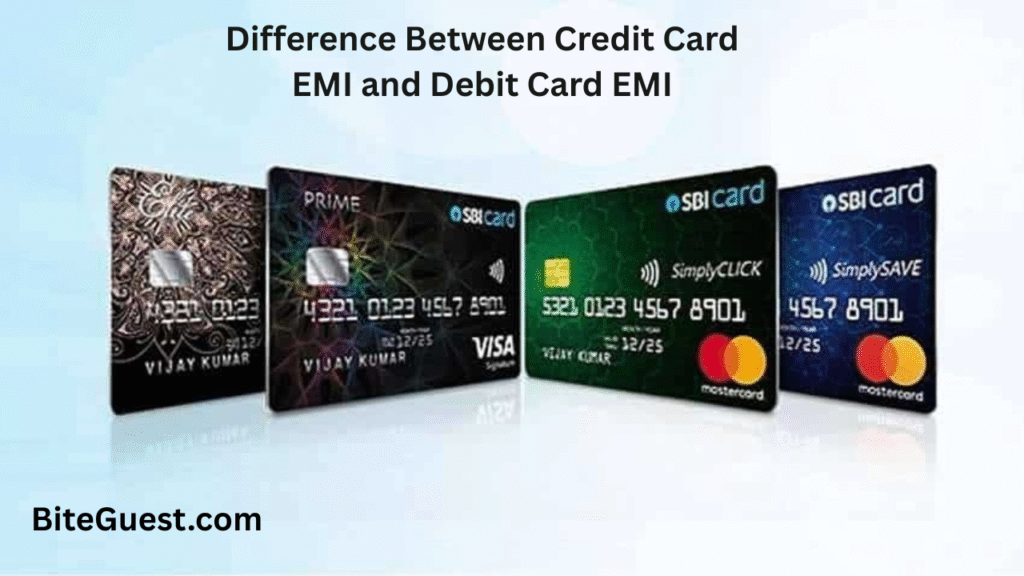
Both credit card EMI and debit card EMI allow you to buy expensive items and pay in small parts over time. However, they work in slightly different ways. Here’s a simple comparison:
| Particulars | Credit Card EMI | Debit Card EMI |
| Payment Method | Done using a credit card. | Done using a debit card. |
| Source of Funds | From your credit limit. | From your bank account. |
| Eligibility | For credit card users only. | For debit card users (the bank decides). |
| Documentation | Sometimes extra papers are needed. | Usually, no papers are needed. |
| Interest Rates | Depends on the card company. | Depends on the bank. |
| Transaction Limit | Based on your credit limit. | Based on your bank balance. |
| Processing Fee | Usually charged. | Usually charged. |
| Payment Structure | Paid in monthly parts. | Paid in monthly parts. |
| Conversion Process | Can change to EMI after buying. | Must choose EMI while buying. |
| Availability | Accepted on most sites and stores. | Available on a few platforms. |
| Flexibility | Offers more time and plan choices. | Fewer options for tenure. |
| Credit Score Impact | It can affect your credit score. | Does not affect the credit score. |
| Extra Benefits | Can get rewards or cashback. | Benefits may vary. |
| Access to Credit | Uses borrowed money. | Use your own money. |
Benefits of Using Free Credit Cards for EMI in 2026
1. Cost Efficiency
Since you are in possession of a card that has no annual fee, your total cost of ownership will be lower. In this case, if you can couple that with EMIs that are favourable to you (0% interest or low interest), it can make it much more appealing than simply paying cash or taking out a high-rate unsecured personal loan.
2. Budgeting & Cash-Flow Management
Turning larger purchases into monthly payments can be a lot easier, not just for budgeting cash flow in terms of managing a lump sum amount that can be paid, especially during uncertainty or for younger consumers trying to build credit history.
3. Access for New Credit-Users
Most free cards have lowered eligibility, making them suitable for new credit users. These new credit users can take their credit and use EMIs to purchase some higher-value items sooner. For example, you might recommend that those using credit for the first time use a lifetime free card.
4. Market Competition Dynamics
In 2026, the market will be competitive: banks and fintechs want to promote EMI transactions, and even free cards are achieving incentives to remain appealing. This is all beneficial for the consumer.
Drawbacks and Limitations
While there are advantages to opening a free credit card, there are also genuine drawbacks to be mindful of:
- Lower rewards and cashback rates compared to premium cards
- Higher EMI interest rates outside promotional offers
- Hidden conversion charges or product markups
- Lower credit limits reduce flexibility for larger purchases
- Behavioral risk: EMIs can encourage overspending if not managed wisely
In short, while EMI options make big purchases easier, they must be handled with discipline to avoid debt traps.
How to Choose the Best Free Credit Card for EMIs
If you are looking at free ards with EMI facilities, consider evaluating:
- Minimum purchase amount for EMI conversion (usually $2,500–$3,000).
- Interest rates on EMI and the frequency of zero-cost offers.
- Available tenure options — does the bank offer 3, 6, 9, or 12 months?
- Processing fees or other hidden charges.
- Credit limit — ensure it suits your intended purchase.
- Retail tie-ups — cards with e-commerce partnerships often offer better EMI deals.
- Penalty structure for missed payments.
- Overall card benefits — rewards, cashback, or travel perks.
Choosing the right card is about balancing affordability and flexibility.
Trend Outlook for 2026 and Beyond
The future of free credit cards and EMI options looks promising. As fintech innovation grows, banks are pushing for instant EMI conversion features, digital-first cards, and AI-powered payment tracking tools. Free cards, once seen as basic, are now evolving into versatile financial tools with better credit-building benefits and smarter EMI integrations.
The trend suggests that by 2027, over 60% of new credit card users may choose lifetime free cards with EMI capabilities — showing that accessibility and flexibility matter more than luxury perks for the average consumer.
Final Thoughts
Free credit cards in 2026 can offer good EMI options if chosen wisely. They help manage large purchases without paying annual fees and provide budgeting flexibility. However, it’s important to check interest rates, tenure, and hidden charges before opting in. Used responsibly, a free card with EMI can be a smart and cost-effective financial tool.
FAQs
1. Can I convert any purchase on a free credit card into EMI?
Mostly yes, but you’ll need to meet the bank’s minimum transaction limit (often ₹2,500). Some cards also restrict EMI options to certain merchants or transaction types.
2. What is a “no-cost EMI”?
A no-cost EMI lets you pay only the product price divided over several months, without paying interest. These are often available through specific retailer-bank tie-ups.
3. Are there hidden charges with EMI on free credit cards?
Sometimes yes. Even if there’s no annual fee, you may be charged a processing or conversion fee (usually 1–2%) or a small markup in product pricing.
4. Will using EMI affect my credit score?
Yes, positively if you make timely payments. Missed or delayed EMIs, however, can lower your score and increase future borrowing costs.
5. Should I choose a free card if I mainly want EMI features?
If your focus is affordability and basic EMI options, a free credit card is ideal. But if you want longer tenures and lower rates, premium cards might be better.